

Haynesville shale gas production has grown ~2 Bcfd since October 2025, but the play’s five largest operators — Aethon/Adamas, BP, Comstock, Expand, and TG Natural Resources — accounted for just ~600 MMcfd. More than 1 Bcfd of the growth came from Apex, the private E&P created from Citadel’s 1Q25 acquisition of Paloma. The hedge fund has since reshaped the E&P in its image, aggressively choking early-life wells and timing TILs to capitalize on gas price contango.
Over the first half of this year, the company ran more rigs and as many frac crews as any other operator in the play. With seasonal spreads again as wide as last year’s, Apex’s growth is likely to surge again in early winter.
How did Apex’s production grow last winter?
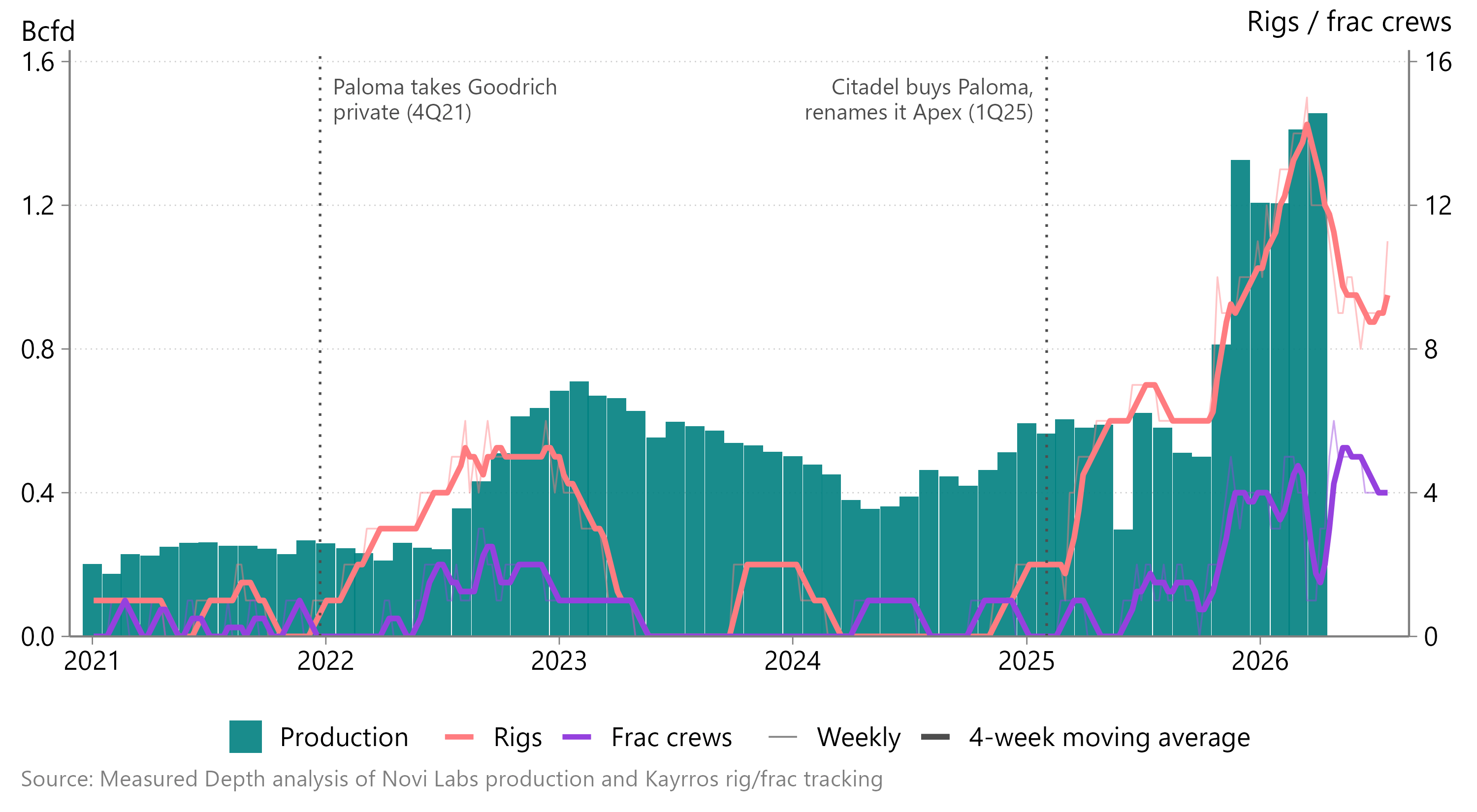
After the acquisition, Apex immediately ramped up drilling activity, from two rigs in winter 2024-25 to seven rigs by June 2025. The company ran just one frac crew in summer 2025, building DUCs and keeping production flat at ~600 MMcfd. But by December, Apex’s Haynesville volumes surged to ~1.4 Bcfd, deploying several tactics simultaneously to boost production alongside rising seasonal prices.
Figure 1 | Apex production and upstream activity
Deferred TILs and excess DUCs
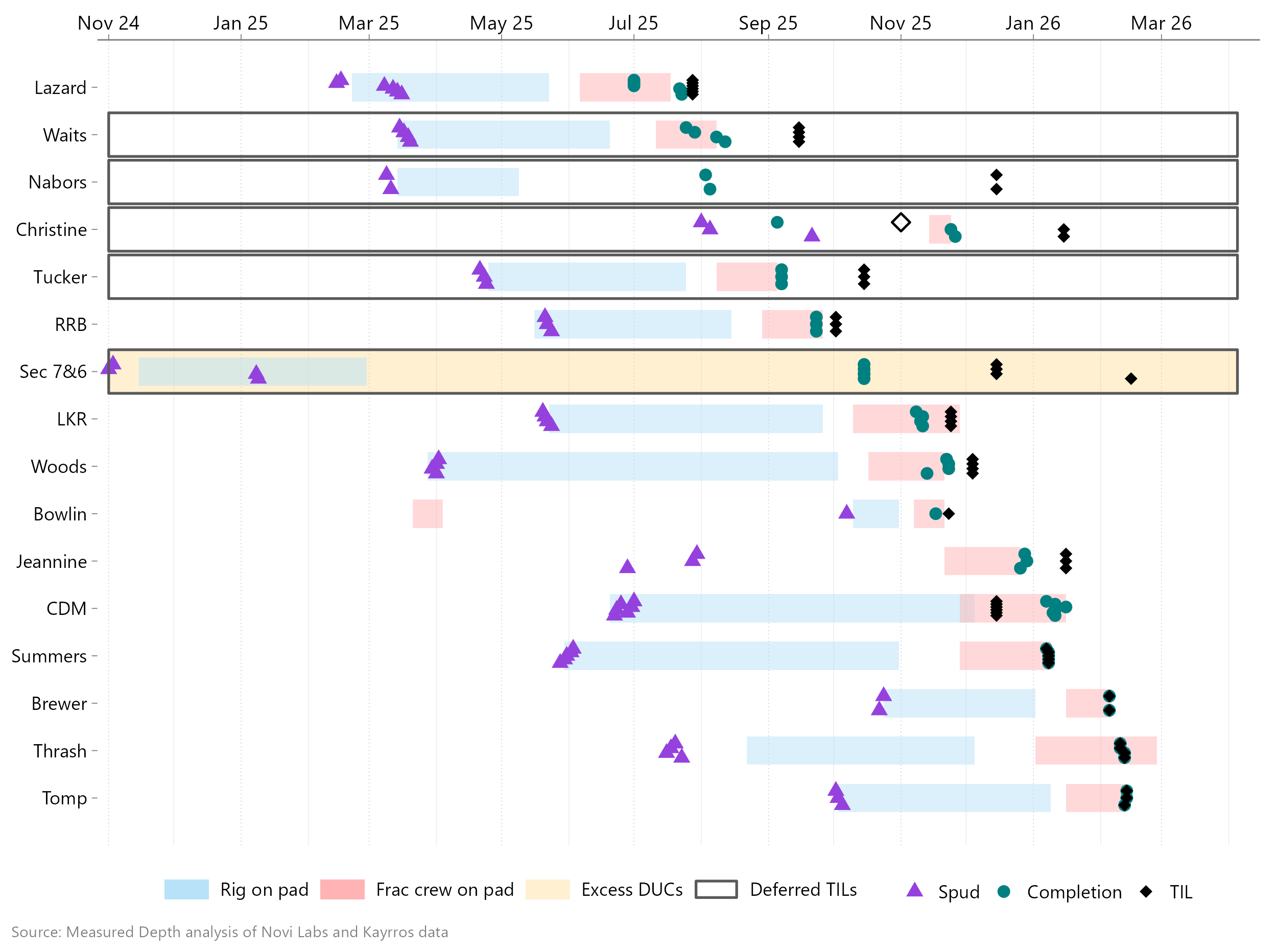
Although market lore holds that Apex accumulated a large backlog of excess DUCs and deferred TILs, in fact deferred TILs and excess DUCs explain less than half — ~300 MMcfd — of the company’s late-2025 production surge.
Of the 13 pads Apex turned in line between September 2025 and February 2026, only five had completed wells sitting idle for more than 21 days after the last well was completed (purple boxes in Figure 2). These TIL delays were generally modest: less than two months for all but one. And only one of these pads (yellow shading) also saw an abnormally long gap between the rig’s departure and the crew’s arrival.
Figure 2 | Apex spuds, completions, and TILs by pad
Aggressive chokes
An equally large driver was Apex’s aggressive choking of wells that came online in 2H25. Across multiple vintages, those wells’ production peaked in December. Expand’s wells, by contrast, peaked in their second month online.
Figure 3 | Apex and Expand type curves1 by vintage