
Ten years after1 I last wrote about it in detail, Constitution Pipeline is still making headlines, and I’m still getting asked about it. My high-level answer is that two things can be true:
New York’s refusal to grant various stream crossing permits,2 with a justification that was more or less “because reasons,” was an egregious abuse of the Clean Water Act.
The project’s FT economics were always marginal for shippers, and its original producer-push premise no longer pencils out.
Because of the first thing, the industry (rightly) has a stick in its craw about this project. But because of the second thing, the project needs to be paired with a downstream expansion.
How we got here, and where Constitution stands now
Constitution dates back to 2012 (!). By late 2016, New York’s denial of water-crossing permits had effectively killed it, until a horse-trading deal last year: President Donald Trump lifted a ban on Empire Wind, and Governor Kathy Hochul agreed not to block gas infrastructure.
Williams CEO Chad Zamarin suggested last month that the pipeline could be online as soon as the end of next year. But even Zamarin’s optimistic comments had a crucial condition: that the project could be online next year if commercial agreements are signed within the next couple of months. None has been announced yet.
Constitution doesn’t access constrained markets
Although Northeast power generators pay some of the highest gas prices in the world on constrained winter days, Constitution does not access these markets. Rather, Constitution terminates at the interconnect between Iroquois and TGP in Wright, New York, meaning that Constitution would displace gas otherwise flowing into Wright on Iroquois (from the north) or TGP (from the west).
Figure 1 | Constitution and interconnecting pipelines
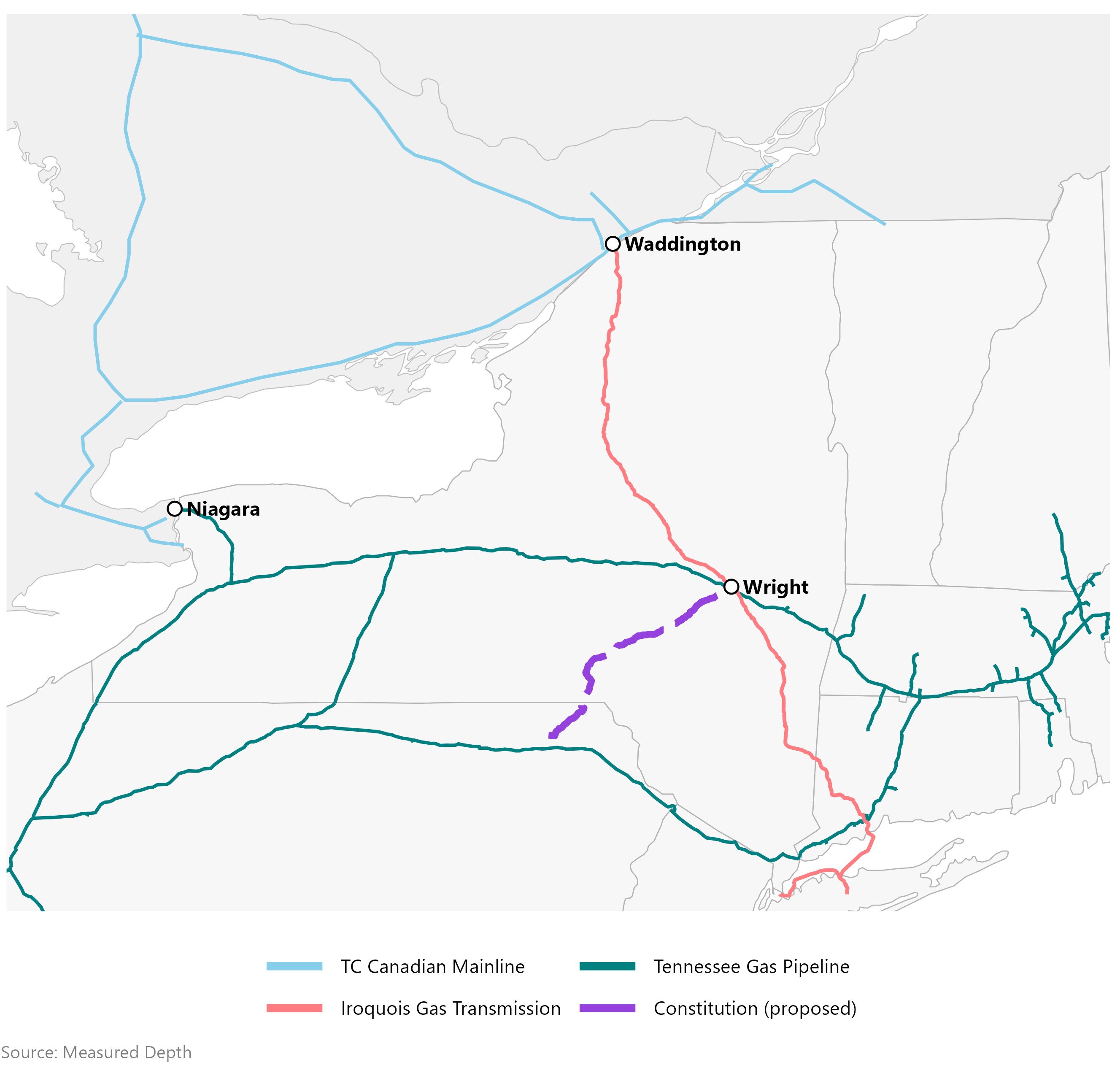
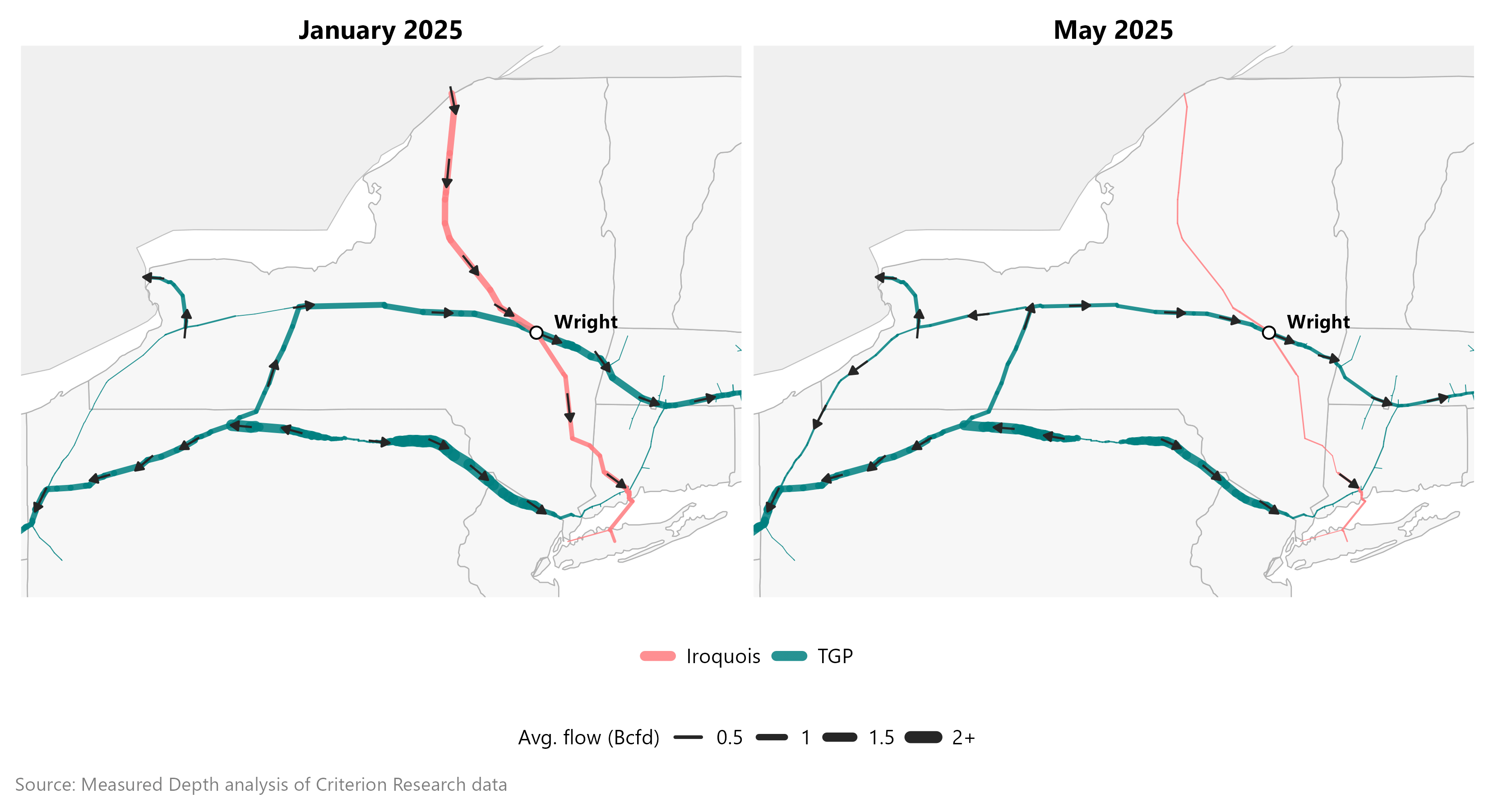
Historically, gas flowed into TGP from Canada at Niagara, but by the time of Constitution’s conception, projects were already under construction to reverse those flows. Constitution’s premise, therefore, was to displace Canadian gas imported at Waddington into Iroquois. Demand seasonality in New England and New York drives the call on gas at Wright, and with it, imports from Canada. Figure 2 illustrates flows on TGP and Iroquois, which, in some months, move as much gas into these premium markets as they can, but in others are underutilized.
Figure 2 | January and May 2025 TGP and Iroquois flows
Last year’s gas flows at Wright reveal which supply sources Constitution would push out. On 142 days, Constitution would have displaced exclusively Canadian gas (Figure 3). On those days, a potential producer shipper would see realized prices in line with those in eastern Canada; these trade meaningfully above Appalachian prices but well below levels in New York or New England.