
Three Northeast-to-Southeast pipeline projects are underway to bridge three key gas transmission constraints on the eastern grid: out of the Northeast when production is too high, into the Southeast on hot summer days, and into the eastern market area on cold winter days.
Both Transco’s Southeast Supply Enhancement and EQT’s MVP Southgate are due online next year and target Northeast takeaway and summer Southeast constraints; only MVP Boost addresses the winter constraint. As I’ll show, Appalachian production elasticity means Northeast basis relief is likely to be short-lived: debottlenecking Transco Station 165 moves the Northeast takeaway constraint upstream to Station 195. Conversely, faster pipeline buildout relative to Southeast combined-cycles means summer Southeast constraints and winter eastern market constraints are less likely in the years immediately after these projects come online.
How much additional Northeast outflow will these projects enable?
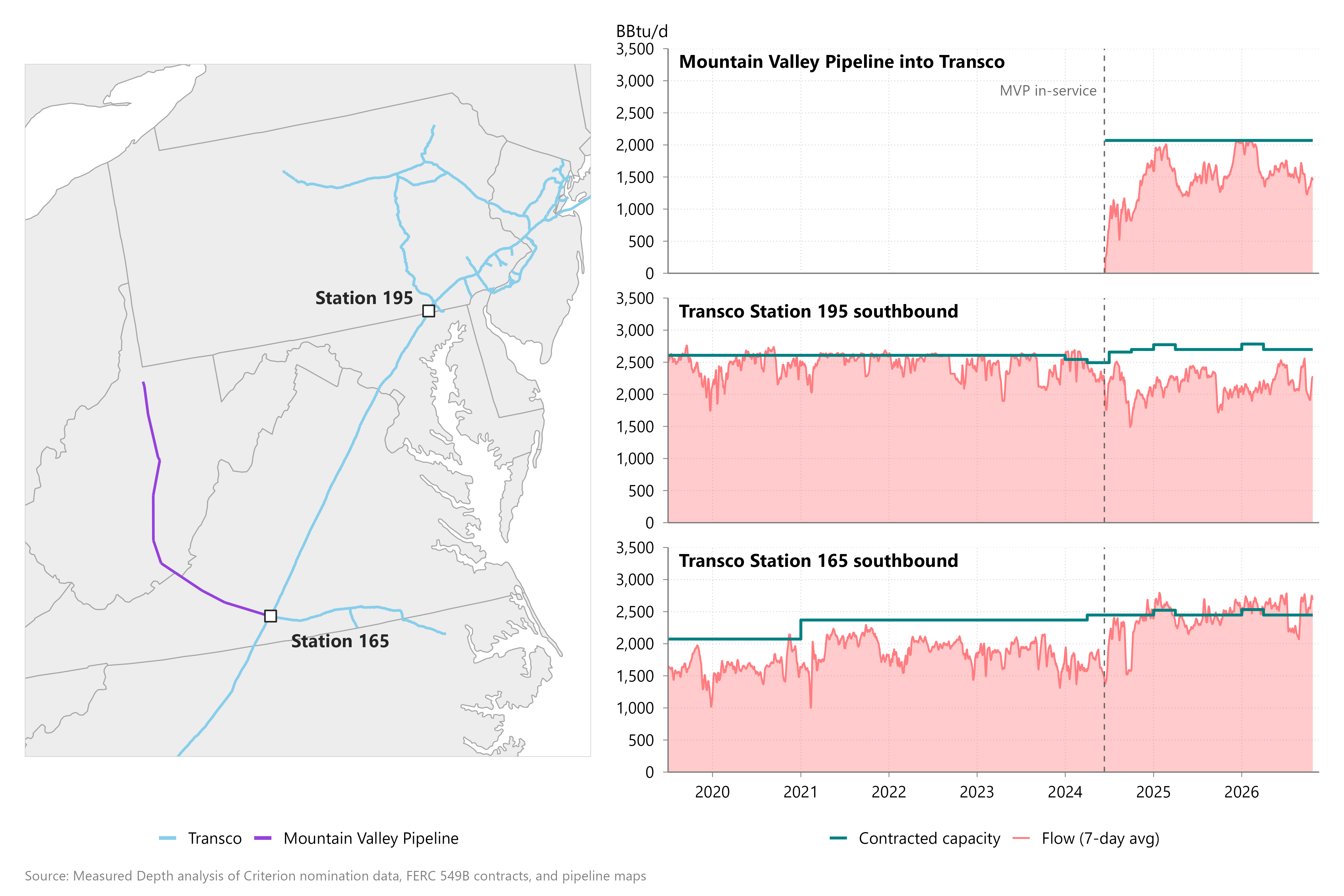
MVP terminates at Transco’s Station 165. As I covered this spring, a southbound constraint at Station 165 limits keeps Transco and MVP underutilized upstream in all but peak winter months.1
Figure 1 | MVP and Transco historical flows
Differences in connectivity will influence how the new projects operate:
Enbridge Gas North Carolina can use its ~300 MMcfd of MVP Southgate capacity to displace its existing Transco flows, freeing up this volume to move farther downstream into Zone 5 on Transco. Duke’s capacity, by contrast, delivers only to its under-construction Person County combined-cycle plant, so it will sit idle until that plant is online.
SSE shippers already buy gas on Transco, so SSE capacity can displace existing Transco purchases. But because SSE shippers receive gas at Station 165, they can source incremental Appalachian gas only if MVP or Station 195 has room.
Figure 2 illustrates how the pipes operate differently in peak (left side) and shoulder months (right side), and how these dynamics will change between now (top panel) and once MVP Southgate and SSE are online (bottom panel).
Now, southbound capacity through Station 165 is full year-round, as illustrated with the full light blue bar at the bottom of the Y-figure. In lower-demand months, both MVP and Transco Station 195 are underutilized, represented by the white space on their arms of the Y-figure. Once MVP Southgate and SSE are online, their shippers will compete for scarce supplies delivered from MVP and through Station 195. These upstream routes will fill year-round, leaving new Southeast capacity from Station 165 underutilized, as shown by the white space in the light blue bar at the bottom of the Y-figure.
Figure 2 | MVP and Transco constraints and utilization