

I’m pushing my Southeast pipeline and combined-cycle buildout post back a week to address EQT’s acquisition of Range Resources, announced yesterday.
EQT is paying a ~21% premium, in stock, for Range. On yesterday’s deal call, EQT CEO Toby Rice emphasized Range’s high-quality inventory, while Range CEO Dennis Degner pointed to EQT’s scale. But by paying a premium for Range’s inventory, EQT is implicitly conceding that its own wasn’t enough to keep growing capital-efficiently — just as Range, by accepting EQT paper, is conceding (as I highlighted in May) that it had no realistic path to scale in Appalachia.
Scale and upstream-midstream integration have been EQT’s flywheel: over the last seven years, it has outgrown every other major Appalachian operator in both volume and percentage terms.
Figure 1 | Appalachian equity production by operator
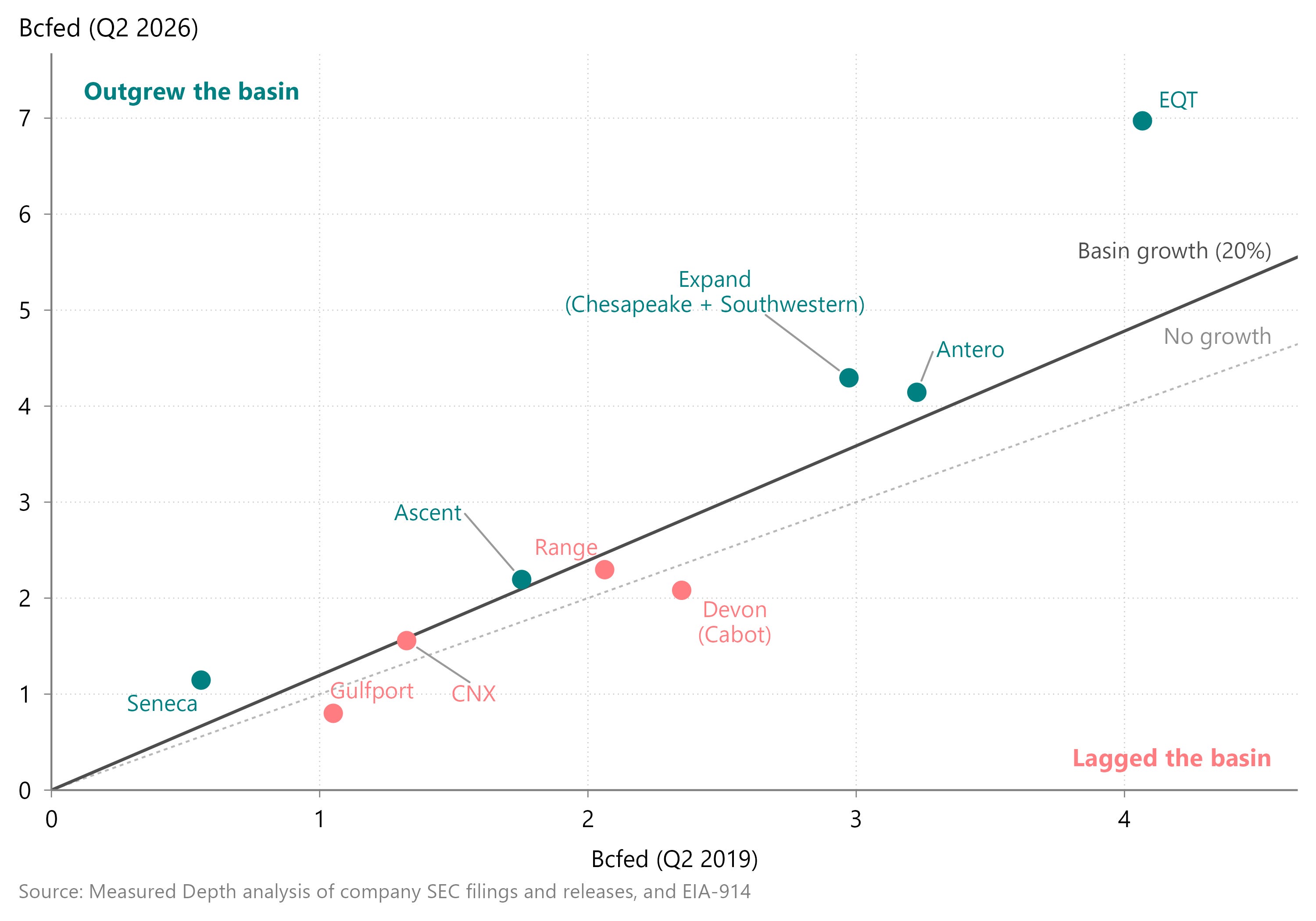
Scale is particularly important in a constrained basin,1 because managing those constraints means sometimes taking a hit — whether via shut-ins or out-of-the-money FT — on a fraction of your volumes, for the benefit of your broader portfolio. Only the largest operators can do that at enough scale to affect whether the basin is constrained consistently or only intermittently.
EQT has managed these constraints more holistically than any peer, and the Range deal reinforces that. It improves the economics of EQT’s curtailment strategy, strengthens the company’s negotiating position with gathering and processing counterparties like Energy Transfer and MarkWest, and enables more capital-efficient growth in southwest Appalachia by moving its best inventory into its cheapest outlets.