

On September 16, Reuters reported that National Fuel Gas is evaluating options for its upstream and midstream businesses, said to be worth ~$5 billion, after an inbound inquiry earlier this year. The company is considering a full or partial asset sale, a merger with another producer, or a spinoff into a separate public company.
National Fuel is unique among major US gas utilities in having such a substantial upstream and midstream business,1 and Seneca — National Fuel’s E&P subsidiary — is unique among US E&Ps in sitting inside a regulated utility. Even ~7% annual production growth gradually makes the combined entity more of an E&P and less of a utility. National Fuel has mitigated Seneca’s rising weight by bulking up its utility business, announcing the $2.6 billion acquisition of CenterPoint’s Ohio gas utility earlier this year, but future acquisitions would be necessary to keep pace with Seneca’s growth.
The cleaner fix is the one the company is now exploring: separating the Seneca assets. As Appalachia’s best inventory runs out and the basin returns to growth, Seneca has three credible paths:
acquiring offset acreage to efficiently scale up as an independent E&P,
being acquired by a large operator, to help it capture more of the basin’s future growth, or
merging with a mid-sized operator, most likely one facing imminent production declines.
I see the last scenario as most likely, and that Ascent is most in need of such a merger, because its production is set to decline before its takeaway capacity rolls off.
Appalachia’s shift back to growth makes inventory more valuable
Cabot, Chesapeake, and Southwestern pioneered northeast Pennsylvania Marcellus development, ramping up activity and production sharply from 2008-13. Dwindling inventory eventually pushed both Cabot and Southwestern to merge into larger companies, and their assets now sit inside Devon and Expand, respectively. In recent years, northeast Pennsylvania production has remained steady in the ~11 Bcfd range, with declines on the legacy Cabot and Southwestern assets offset by growth from Repsol, Seneca, and others.
Figure 1 | Northeast Pennsylvania production by operator
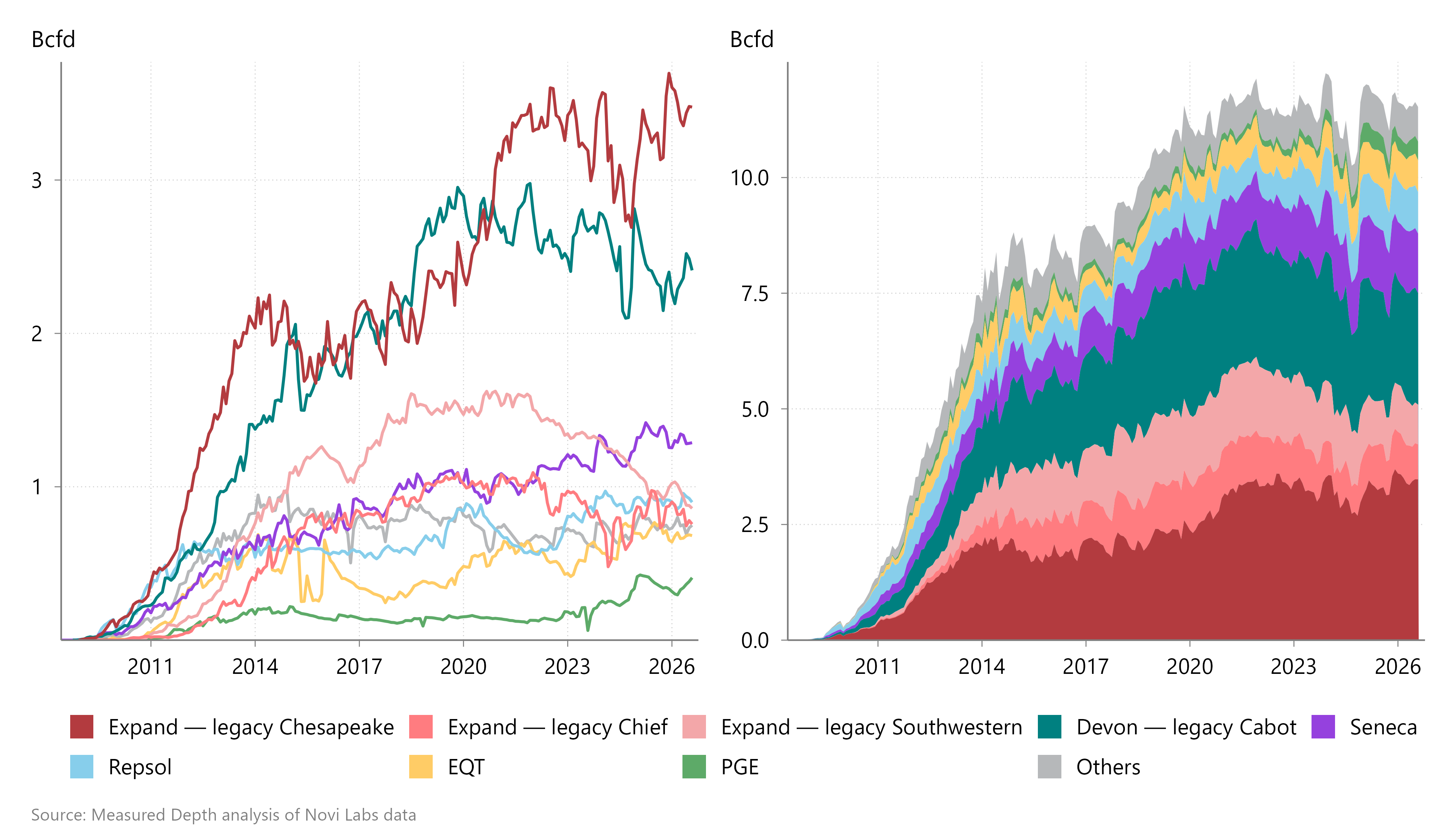
Because northeast Pennsylvania sits inside a nested constraint within Appalachia, production is likely to remain at this ~11 Bcfd level until new intra-Northeast projects are developed, although individual northeast Pennsylvania operators can grow as legacy assets decline. Rising Northeast demand and new takeaway projects will also narrow Appalachian basis discounts, incentivizing production growth and strengthening the case for new intra-Northeast capacity.
But the quality of remaining Appalachian inventory has deteriorated since the basin was last in growth mode, so a different set of assets and operators will lead the next phase of growth. I expect operators to maintain production on a given asset2 as long as they can, and for the next-best assets — defined by both productivity and remaining inventory life — to ramp up once mature ones go into decline.
Good-but-not-great acreage gains value every year, as great inventory runs out, so companies like Seneca3 are well-positioned for long-term growth.
Figure 2 | Appalachian dry gas production forecast by sub-basin and operator