

Last week, I showed that structural growth in gas-fired generation has stalled even as load growth accelerates, largely because coal retirements have slowed. This week, I’ll show why: for the first time on record, US CC capacity has little headroom in many markets.
This slowdown in structural gas growth is concentrated where CCs are most heavily utilized. And while today’s coal retirement delays reflect market fundamentals more than politics, the thin pipeline of new CCs is a lagged effect of the early 2020s’ decarbonization push. As a result, relief in power markets — and with it, faster gas demand growth — is still two years away.
Where is CC capacity heavily utilized?
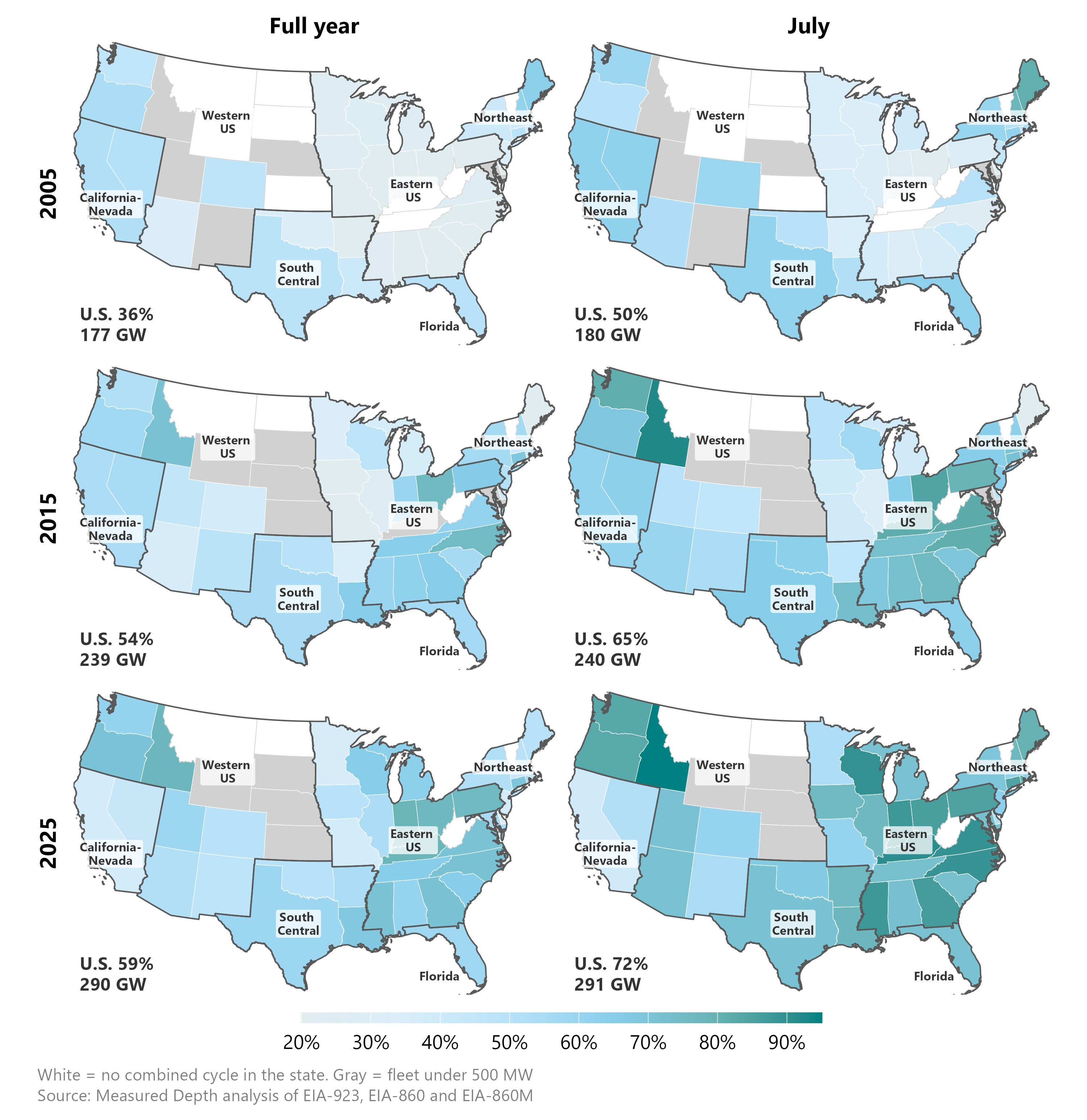
Nationwide, CC capacity is running at its highest-ever utilization rates: ~60% annually and ~75% in July, up from ~50% and ~65% as recently as 2017. Even at these levels, CCs can ramp up during unusual conditions like extreme weather or low gas prices. But in most of the country, CC utilization is now too high to retire much additional coal capacity.
Figure 1 | US CC capacity factors by state
How is the fossil fleet running now?
CC utilization rates are higher still in most of the eastern half of the country, which spans both regulated and deregulated markets, gas-rich and gas-poor states, and varying degrees of political emphasis on decarbonization. Across the eastern US states bounded by Mississippi, Minnesota, Pennsylvania, and Georgia (top-left panel in Figure 2), CC capacity factors have risen sharply alongside a consistent buildout in CC capacity from 2003-23. Over the last 12 months, this ~107 GW fleet ran at a ~70% capacity factor — harder than the region’s coal fleet did in the mid-2000s.
Conversely, in California and Nevada (bottom-right panel), where sunny weather makes solar development more economic, CC utilization has fallen. In Florida (bottom-left panel), where strong load growth is nothing new and utilities have little interregional transmission to fall back on, the CC buildout has kept pace with demand and coal retirements.
Because load growth outran what generators expected, all dispatchable capacity — including coal — is now more valuable. For the first time in the shale era, coal capacity factors are also rising: from a (non-pandemic) low of ~42% in 2023 and 2024 to ~47% over the last year, the highest since 2019. Rising utilization, more than politics, is what’s keeping more coal plants open, at least until new gas capacity is in place.
Figure 2 | Gas CC and coal fleet capacity factors by region