This is the third in a series digging into the most interesting topics from 1Q26 earnings season. Last week, I covered Antero’s continued transition to dry gas, and the week before, midstream operators’ commentary on Permian production growth relative to takeaway capacity additions.
In 4Q25 earnings season, developers announced three major projects that would pull Appalachian gas west to serve growing Midwest data-center demand. Now this quarter, two additional project announcements point to even more gas-fired generation growth in the same area:
DT Midstream closed an oversubscribed — albeit non-binding — open season on its Midwest Incremental Supply Transportation project on Midwestern
TC Energy formally sanctioned the Appalachia Supply Project on its Columbia Gas (TCO) system
Both projects are early in their development lifecycles, with no FERC filings yet, but both confirm a rising call on gas-fired generation generally and growing upside in the middle of the country specifically. The Appalachia Supply Project is the more advanced of the two, with an anchor shipper already in place, although TC has disclosed little and not yet held an open season. Even so, its earnings-season comments confirm the project will lift Northeast E&Ps’ volumes and realized prices. MIST, meanwhile, will improve realized prices for Appalachian operators with REX capacity, but its incremental volumes are more likely to come from the Rockies.
DTM’s MIST project on Midwestern
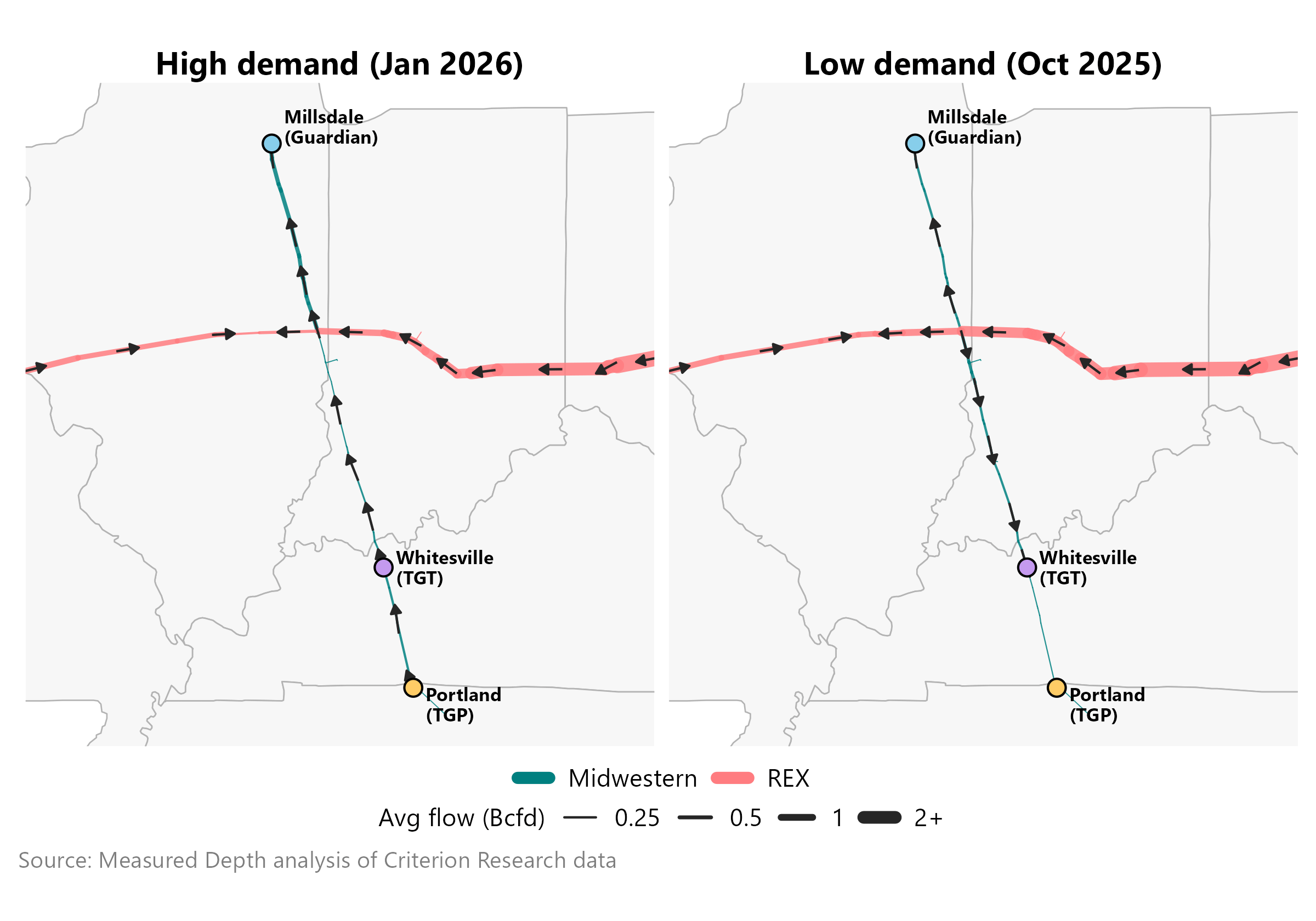
On its 1Q26 earnings call, DT Midstream said customer interest exceeded MIST’s proposed 1.5 Bcfd of capacity, with shippers interested in both the northbound and southbound paths. DTM highlighted Midwestern’s connectivity with “pipelines that traverse all the way down to the Gulf,” suggesting customers interested in stacking Midwestern with either TGP or TGT capacity, which interconnect with Midwestern near its southern end (Figure 1).
Now, on high-demand days, gas moves north across the entire Midwestern system, sourcing some TGP volumes at its southern end and delivering mostly to customers north of REX. In shoulder months, though, gas moves both north and south from REX.
Figure 1 | Midwestern and REX flows in high- and low-demand months
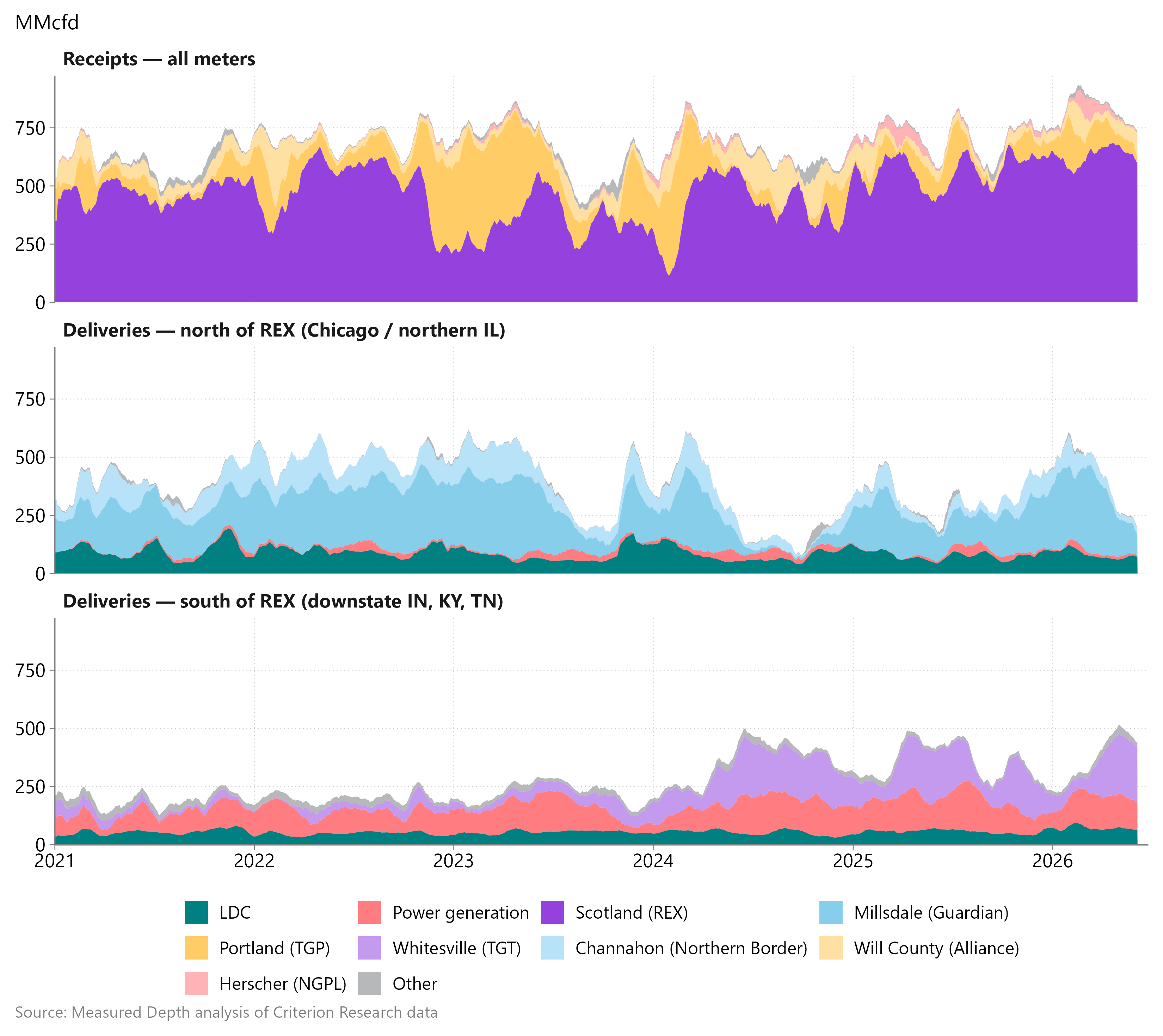
REX supplies (purple area in Figure 2) the overwhelming majority of gas on Midwestern, and these volumes move into Midwest delivery pipes including Guardian (light blue area) in the north, and to both end-users and Texas Gas (light purple) in the south.
Figure 2 | Midwestern supply and customer mix (30-day moving average)