

The pace of Permian pipeline capacity under construction is unprecedented — but so too are Waha prices this spring, suggesting excessive curtailments of gas production due to takeaway capacity constraints. These shut-ins accumulated because of an anemic capacity buildout: just ~3.5 Bcfd over the last 3.5 years, prior to the in-service of Gulf Coast Express’s ~550 MMcfd expansion this month.
In its April fundamentals presentation, Enterprise pegged curtailments at 2.0-2.5 Bcfd, and a growing subset of analysts now expect the ~4.6 Bcfd of Permian capacity due online over the next year to fill immediately. Whether that happens depends on two factors:
How much production is curtailed currently
How much production is likely to grow from this point forward
Given the complexity of this topic, I’ll cover the latter in a follow-up post. The former is more challenging in the Permian than it would be in any other basin for two reasons: pipeline scrapes have more noise than signal for Permian production, and while most wells report within 2-3 months of when they begin producing, the long tail of Texas well data trickles in over more than a year.
To address these issues, I’ll triangulate between frac-crew tracking, pricing data, and meta-analysis of state reporting to estimate what Permian dry gas production “should” be currently and, therefore, how much volume is likely curtailed. As I’ll show, Enterprise’s curtailment estimate was likely conservative as of April, due to a surge in March TILs. Since then, easing completion activity and the GCX expansion coming online likely pushed curtailments down to ~1.2 Bcfd.
Volumes (including wellhead shut-ins) from reported wells
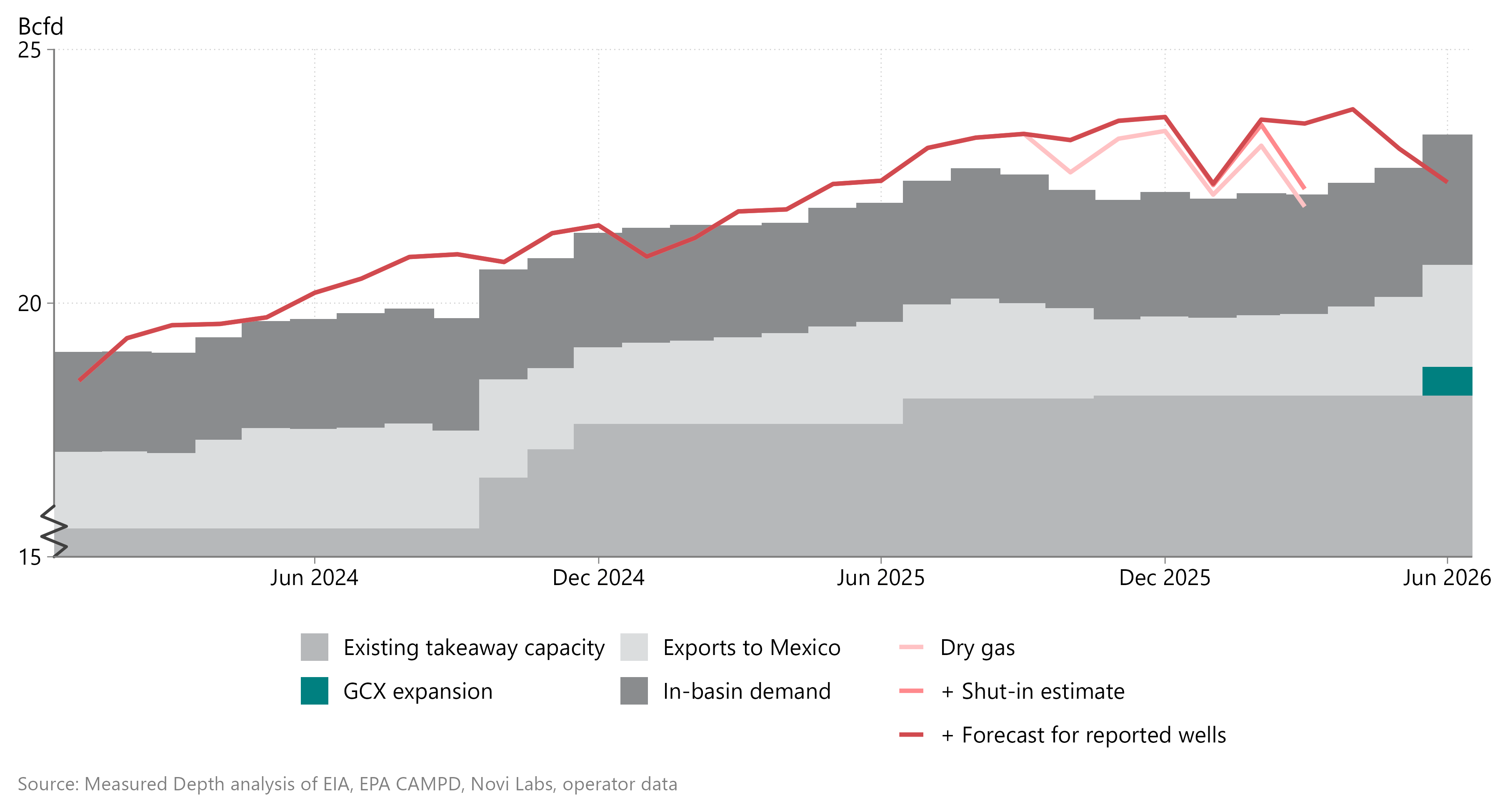
As of yesterday, state regulatory agencies reported ~28 Bcfd of Permian wellhead gas production for March 2026, which translates to ~22 Bcfd of dry gas.1 Although most Permian production has oil-weighted revenue streams and therefore little incentive to shut in when Waha prices are negative, some wells are more gas-weighted and respond to gas price signals. These shut-ins mean that true wellhead production potential is understated even in reported data. I analyze cohort-specific gas-oil ratios to identify where reported wellhead gas volumes fell short of what we would expect given oil production levels, indicating price-driven wellhead gas shut-ins.2
Altogether, these curtailments add ~400 MMcfd of missing wellhead production in state-reported data for February and March. Because Arps-based type curves tend to understate gas volumes in oil plays, I use a combination of oil type curves and the typical trajectory of gas-oil ratios over a well’s life3 to estimate production from these wells since March. This translates to 22.4 Bcfd in June, which in-basin demand and takeaway capacity would easily accommodate. But this estimate is incomplete because it does not account for wells that are already producing but have not yet been reported by state regulatory agencies.
Figure 1 | Permian gas production and takeaway capacity
Reported completions not yet reported producing
These wells constitute the biggest source of uncertainty in estimating current Permian gas production because we don’t know how many there are. The last two months are instructive but by no means unique. Over that period, most of the Permian wells newly disclosed by the RRC (medium and light gray bars in Figure 2) started producing in March or April. But an additional four of them started producing in July 2024, meaning it takes more than a year to have a complete picture of Permian wellhead volumes.