

In Expand’s 4Q25 earnings call, Chairman and interim CEO Mike Wichterich made headlines calling for a $0.20/MMBtu uplift in the company’s realized prices, equivalent to ~$500 million annually, from improved marketing margins. On the eve of its 2Q26 earnings call, Expand made a major move toward achieving this target, announcing the acquisition of marketer Twin Eagle for $1.25 billion.
Reduced coal-gas competition, capital-discipline-era supply inelasticity, 15 years of storage underinvestment, and rising power and LNG demand combine to drive continued increases in gas price volatility. And this rising volatility creates outsize profits for companies positioned on the right side of it, which Expand now clearly aims to be. In conjunction with the deal, Wichterich announced an increase in target incremental marketing profits from $500 million to $750 million annually.
But realizing that value depends on future strategic decisions around contracting and risk management, not the book of deals that Twin Eagle currently holds. If successful, Expand will differentiate itself from smaller gas E&P peers, none of whom has the scale to execute a similar playbook. If not, the volatility-induced profits will remain concentrated among the funds and consumers (and EQT) that are willing to shoulder the associated risk.
Limited immediate FT integration
Producers typically contract for FT to backstop needed takeaway capacity from constrained basins, whereas marketers and traders view pipeline capacity as an option and make contracting decisions accordingly. Expand’s interstate FT — from both legacy Southwestern and legacy Chesapeake — moves gas from Marcellus and Haynesville producing areas to markets in the Northeast, Midwest, and Gulf Coast. Twin Eagle’s capacity is for smaller quantities (thinner lines in Figure 1) and is more geographically diffuse.
Immediate integration opportunities are likely limited to the Midwest. Some of Expand’s Rover and REX volumes might be able to flow into Twin Eagle’s capacity, although it’s uncertain because the receipt points are out of path. If these volumes are successfully scheduled further downstream, Expand’s realized prices would improve during peak winter heating months.
Figure 1 | Expand and Twin Eagle US interstate FT (2026Q3)
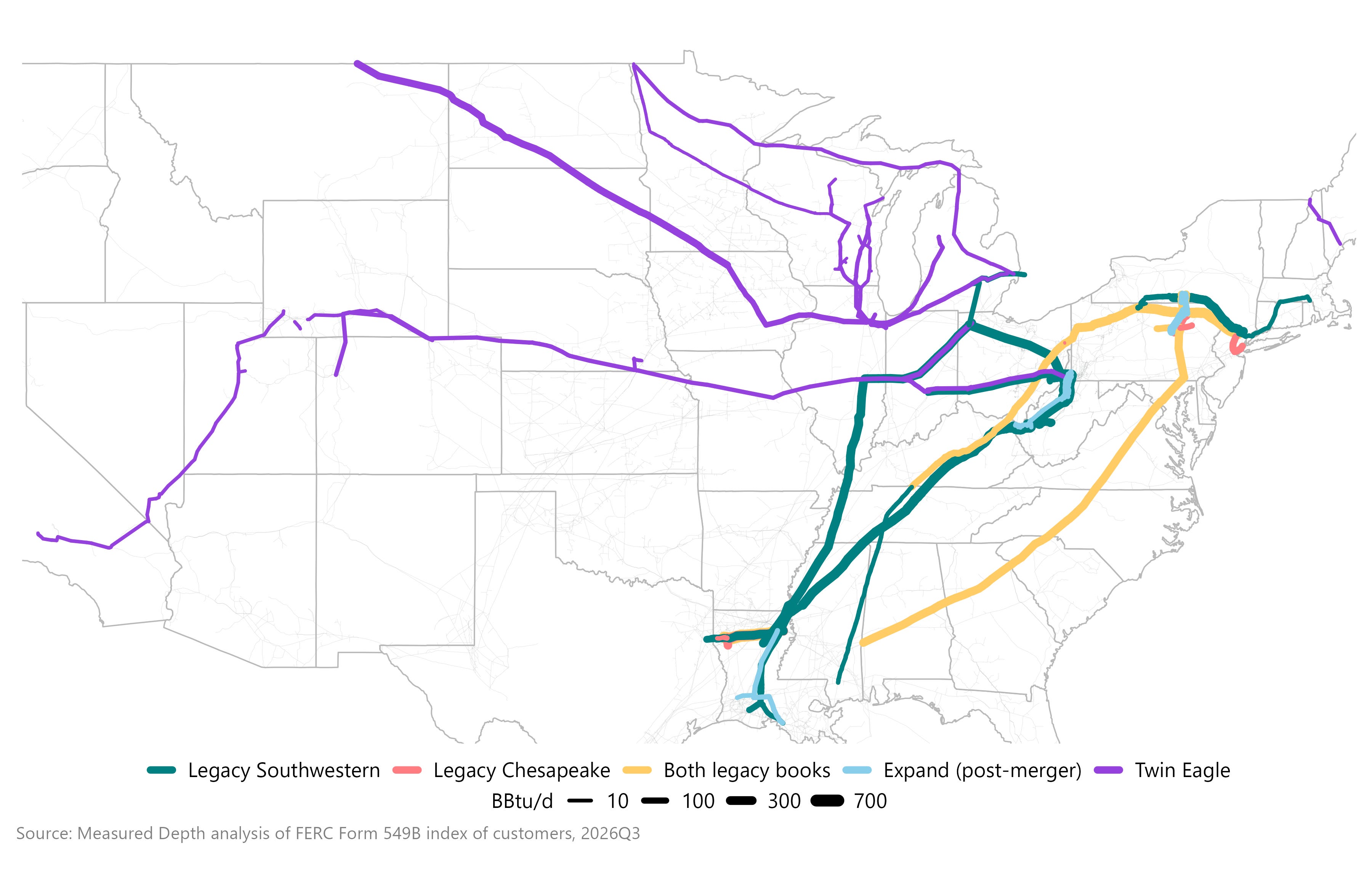
But in that scenario, Expand’s improved realized prices cannibalize what would otherwise have been Twin Eagle marketing profits. Pre-deal, Twin Eagle could buy either Expand’s or another producer’s gas and capture the value of its capacity. To the extent that these volumes came from another producer, the pro forma entity could unlock perhaps a couple cents per MMBtu of marketing margin. But the bigger incremental benefits to the combined organization depend on future FT or other strategic marketing decisions.
Strategic rationale
The strategic rationale, therefore, is more about the Twin Eagle team and its capabilities than the specific capacity agreements. That capacity position itself is likely to change: Twin Eagle’s FT is not just for smaller capacities but also for much shorter tenors, as shown in Figure 2.
Figure 2 | Expand and Twin Eagle US interstate FT history