

Happy (belated) 4th of July to all who celebrate! In honor of the long weekend and America’s 250th birthday — which I’m celebrating with my family in a national park — I wanted to step back from power generation and Permian production forecasts to both thank Measured Depth subscribers and provide an update on this endeavor.
When I launched this project late last year, I posed three questions that I was hoping to answer:
Whether research alone is a viable business
And if it is, whether subscribers would want something broader or deeper, whether they’d want more attention on production or power or LNG
Which of my potential product ideas could have a market
This week, I’ll cover what I’ve learned since then and ask for your feedback, both generally and on a few specific questions. I've put together a short reader survey, and I’d really value your free-response feedback. I’ll comp a month’s subscription for responses I find especially helpful.
Is research alone a viable business?
Eight months into this endeavor, and four months into paid subscriptions, Measured Depth has:
Three enterprise subscriptions. I’m very grateful to them, all of whom I knew as clients prior to launching this endeavor.
An additional ~25 individual subscribers, each from a different company.1
~800 more subscribers to the free version
Relative to what I expected at the outset, Measured Depth has more free subscribers but fewer paid subscribers. And the paid subscription trends also differed from what I anticipated; I thought perhaps 5-10% of free subscribers would pay initially, but that hardly anyone would upgrade afterward. Instead, only about 10 people upgraded to a paid subscription in March, but about half that many have signed up each month thereafter. Realistically, I probably need to double the paid subscription levels for the weekly publication to be worth it, but I’m optimistic that I’ll reach that level within the next 6-12 months.
But perhaps that confidence is misplaced! To that end, I’d like to understand how each of you is thinking about subscribing.
What do subscribers want?
From page views and subscription rates, I have a sense of which topics resonate most strongly with subscribers. But honestly, the readership statistics have been more similar across posts than I expected, suggesting that there aren’t universally “most interesting” topics, but rather a range, each of which resonates with a different subset of Measured Depth subscribers.
And while I’m proud of this range — several angles around LNG exports, coal-gas competition and coal retirements, analytical methodology, Permian production, Appalachia takeaway and new projects, load growth and more — I’m less sure whether it’s the right direction for this publication, relative to something more focused.
I’m not ever going to have a daily fundamentals product like RBN or Criterion or Genscape, or comprehensive coverage of the energy value chain like WoodMac or CERA. I do think I’m offering differentiated depth and quality of analysis and providing unique strategic and tactical insight. And as I build more foundational tools, I’ll have more time to incrementally add functionality and improve the offering. The question I can’t answer from readership statistics, though, is what latent interest subscribers have, and what direction you’d like to see those product improvements take.
Which product ideas could have a market?
About a year ago, my cousin — who works for a small private Permian E&P — came to Houston for a board meeting and wanted to talk about two things: the prospects for higher Waha prices and AI. I told him I more or less wasn’t using AI at all, and he was stunned. At the time, I had a team of 10 or so people, so I spent a lot of time in meetings and wasn’t writing much code myself.
When I wrote in November about launching this venture, I had seen enough to know that AI would make it easier, but in retrospect, I had no idea how much easier. As a parent, I often wonder how AI will reshape jobs by the time my kids are interviewing.2 As an analyst, though, I feel like these tools were made for me: someone with subject-matter expertise who thinks algorithmically, but whose ideas for new models far outpaced her time (or capability3) to build them.
I’ve never set up a database before, or scraped data at scale, or digitized pipelines, but I’ve used these tools enough to know what I’m looking for, and what to ask Claude for direction on. I know it’s trite, but truly, what a time this is to be alive. I’ve been able to build products much faster than I expected, and am excited to share some of those with you this fall.
In the weekly posts, you’ve seen some graphics illustrating pipeline capacity by location, which I can now do algorithmically with location, shapefile, and index of customers data. I want to add more functionality to the application, but I have enough pipelines (Figure 1) digitized to be useful.
Figure 1 | Lower-48 contracted interstate capacity
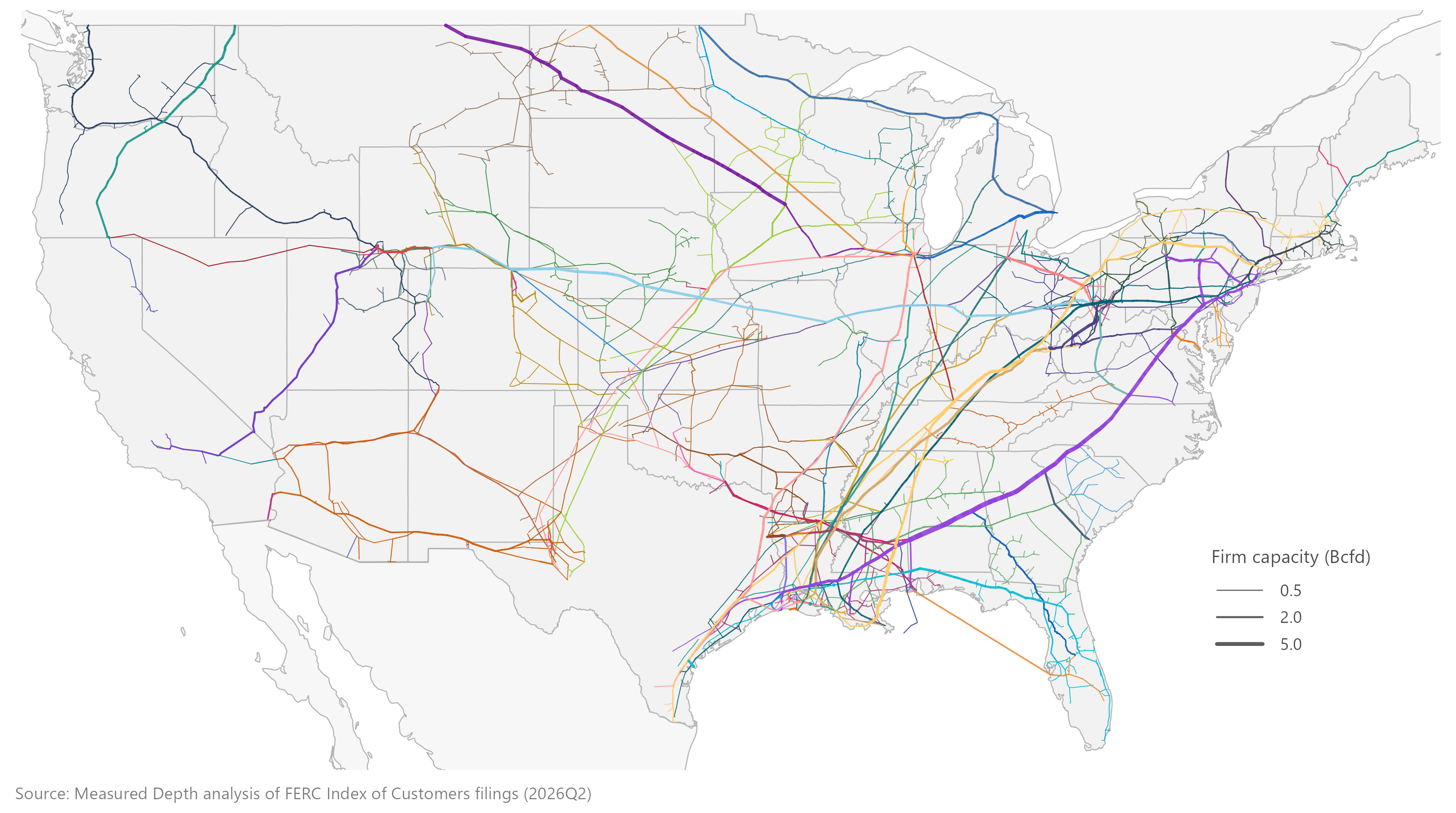
Then, over the next few months, I want to use this contracted capacity as the backbone of a gas flow model. Maintaining infrastructure data is a major challenge in the traditional approach to gas flow forecasting, so my hope is to streamline this process using the IOC and nodal structures. And then there’s my white whale — a supply model — which I’ve been developing with a partner and hope to begin scaling in the coming months.
If you or your firm would be interested in hearing more about any of these products, please get in touch so I can set up a meeting. Of course, I’d love to hear your thoughts on my survey questions, too. In the meantime, happy belated 4th, and thanks for reading!
I don’t know who everyone is, so I can’t say this with 100% certainty, but it’s at least true of the ones who signed up with corporate e-mail addresses or who I can easily identify from the subscriber’s name
Luckily, we have some time: they’re 13, 10.5, and 8 now. And my oldest is taking a Python class over the summer, if that gives you any indication of how I’m thinking about it so far.
I used to joke that I could code just well enough to be dangerous.